The Hemline’s Long Detour: Why Skirt Lengths Keep Changing
Skirt hemline history shows how length, silhouette and occasion shaped dress in distinct periods, helping you interpret historical clothing without treating hems as fixed codes.
The most common mistake in reading a skirt is to treat its hem as a fixed code: a short skirt means one thing, a long one another. Skirt hemline history is more specific than that. A hem gains meaning from its silhouette, occasion and period, so compare those details before drawing conclusions.
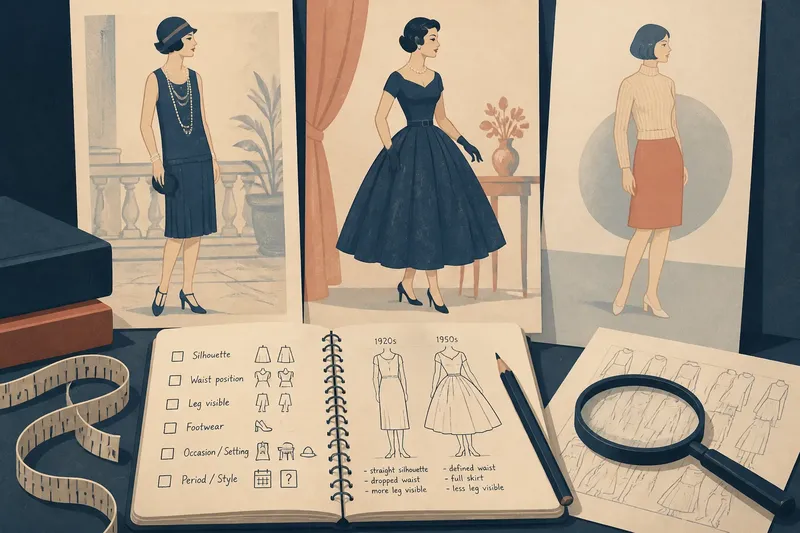
A hemline is the lower edge of a garment, but its visual effect depends on more than where it falls. A narrow skirt ending at the ankle and a full skirt ending there create different outlines. Historical examples make the point clearly: the full skirts of the 1950s New Look, with their defined waists and voluminous shapes, differ sharply from the straight miniskirts associated with mid-1960s fashion. The hem is only one part of each look.
Read the hem alongside the silhouette
Silhouette means the overall outline a garment makes on the body. A skirt’s volume, waist position and cut can change how its length appears. A full skirt may seem ceremonious, while a narrow one at the same point on the leg can look spare. The 1950s New Look is a useful reference: its full skirt and shaped waist made a different impression from the shorter, straighter lines seen in 1960s miniskirt fashion.
Length is not a standalone explanation. A shortened skirt may alter the proportions of an outfit, but its effect also depends on the bodice, footwear and layers beneath it. When studying an image, trace the outline from shoulder to hem. Note the waist position, skirt shape and visible shoes before comparing the hem itself.
Place each skirt in its historical setting
The 1920s flapper silhouette offers a concrete example of changing proportions. Many fashionable dresses of the period used a straighter shape and a dropped waist, with skirts that exposed more of the lower leg than many earlier fashionable styles. That look is often associated with changing ideas about women’s appearance and movement, but one dress or image cannot establish what every woman wore or thought.
Compare that silhouette with the New Look introduced by Christian Dior in 1947: a defined waist and a full, long skirt made a markedly different outline. This shift was not simply a return to an earlier hem position. Volume, waist emphasis and the image of femininity all contributed to the contrast. The named styles offer evidence for describing fashion ideals, not a complete account of everyday clothing.
Occasion matters as well. A fashion illustration may present an ideal, while a photograph of work clothes shows a garment in a particular use. A skirt worn for ceremony may follow different expectations from one worn for daily tasks. Avoid treating one image as representative of a whole society.
Compare period details before judging the hem
Say you are comparing a 1920s fashion plate showing a dropped-waist, relatively straight dress with a 1950s New Look photograph showing a fitted waist and full skirt. First, record each skirt’s outline: straight for the earlier image, voluminous for the later one. Next, note the waist position and how much leg and footwear are visible. Then describe the difference without assigning motive: the first image presents a straighter, more leg-revealing silhouette; the second presents a defined waist and expanded skirt. The comparison supports an account of changing fashionable proportions, but it does not prove that every wearer followed either ideal.
For your own comparison, use a small set of visible details:
- Check whether the skirt is narrow or full; if narrow, describe its vertical line, and if full, describe how it spreads.
- Check where the waist appears; if it is raised or dropped, include that proportion in your description, and if it is unclear, do not infer it.
- Check how much leg is visible; if the image shows it clearly, record the hem’s position relative to the body, and if not, mark the position as uncertain.
- Check whether shoes are visible; if they are, note how the skirt meets them, and if they are hidden, leave footwear out of the comparison.
- Check the image’s setting or caption; if it identifies work, ceremony or fashion illustration, use that context, and if it does not, avoid guessing the occasion.
- Check whether the images belong to a named period or style; if they do, compare like with like where possible, and if they do not, describe the visible differences without dating them more precisely.
Separate what you see from what you infer
“The skirt ends near the ankle and has a full outline” is an observation. “The wearer intended to appear respectable” is a claim about motive, and the image may not support it. Keep those statements apart, especially when captions are brief or an image has been chosen to represent a period.
Fashion does not move in one direction, with skirts steadily shortening as society becomes more modern. The contrast between the dropped-waist styles of the 1920s and the full-skirted New Look of the late 1940s and 1950s shows that silhouettes can shift sharply. Older shapes may also return in altered combinations, so a familiar hem position need not carry the same associations in a new setting.
Questions readers ask about skirt hemline history?
Does a shorter hem always signal rebellion?
No. A shorter hem may depart from a convention in one setting, then become familiar as fashions change. Compare the full outfit and its context before assigning that meaning.
Does a long skirt always signal modesty?
No. A long hem can accompany formal dress, a fashionable silhouette or a particular convention. Length alone cannot establish the wearer’s motive.
Why can skirts with similar hems look different?
Volume, cut, waist placement and footwear alter the outline around the hem. The full skirt of the 1950s New Look, for instance, creates a different shape from a narrow skirt ending at a similar point.
How can I tell whether an image shows everyday clothing?
Look for a caption, setting and visual clues such as work-related activity or formal staging. If the source does not establish the occasion, describe what is visible rather than deciding that the outfit represents everyday dress.
Focus on comparisons that the image supports
Not worth the effort: assigning a universal meaning to each hem position or making a precise judgement about someone’s character from one picture. A careful comparison is more useful. Record the hem, describe the silhouette, identify the occasion if the source supports it, and keep any broader interpretation cautious.
Skirt hemline history becomes easier to read when length is treated as a relationship rather than a code. Compare named styles such as the 1920s dropped-waist silhouette and the 1950s New Look, then describe what the image shows before interpreting what it might mean. That approach gives you a grounded account without asking the hem to explain more than it can.